




Finding the Right Rain Jacket for Your Bike

Choosing the right rain jacket for your bike heavily depends on how and where you ride. There isn't one perfect jacket for all situations. So, first consider what you mainly need it for. Are you more of a sporty road cyclist, are you tackling trails on a mountain bike, or do you use your bike daily for commuting to work? Each of these situations places different demands on a rain jacket.
Purpose Determines Jacket Choice
For road cyclists, every gram and every bit of aerodynamics often counts. Lightweight, small-packable jackets without much fuss are ideal here. They easily fit into a jersey pocket and are quickly at hand when it gets wet. Mountain bikers and touring cyclists often need a bit more robustness and comfort, as they might carry a backpack or ride off-road. Here, the jacket can be a bit thicker and better ventilated so it doesn't immediately turn into a sweatbox during exertion. Commuters who ride daily in all weathers value durability and good weather protection. A slightly looser fit, allowing for a warmer layer underneath, is often an advantage here.
Materials and Their Properties
Modern rain jackets for cyclists are often made from functional materials that achieve two seemingly contradictory things: they keep rain out but allow sweat to escape from the inside. This works through special membranes. The pores in these membranes are small enough that raindrops cannot pass through, but large enough that water vapor (i.e., sweat) can escape.
The water column indicates how waterproof the material is – the higher the value, the better the protection against rain. Breathability is often given in grams per square meter per 24 hours (g/m²/24h); a higher value means that more moisture can escape.
Fit and Cut for Cyclists
A good cycling rain jacket differs from a normal rain jacket primarily in its cut. Since cyclists often adopt a hunched posture, the jackets are usually cut longer at the back. The sleeves are also often a bit longer so that the hands are well covered when riding. A too-tight cut can restrict freedom of movement, while a too-loose jacket can flap in the wind. Pay attention to details such as adjustable cuffs and a well-fitting collar that also protects against wind and rain.
Important Features of a Good Cycling Rain Jacket
Waterproofness and Breathability
A good cycling rain jacket must protect you from rain, but at the same time ensure that you don't get wet from the inside. This is a balancing act that modern materials master well. Waterproofness is often indicated by a water column rating. The higher this value, the better the jacket seals. Values from 10,000 mm are usually sufficient for cyclists. At the same time, breathability is important. It indicates how well water vapor (i.e., sweat) can escape from the inside to the outside.
A high MVTR (Moisture Vapor Transmission Rate) value is a good sign here. It indicates how many grams of water vapor per square meter can pass through the material in 24 hours. Values above 20,000 g/m²/24h are very good.
The balance between waterproofness and breathability is crucial to keep you dry on the bike – from the outside and the inside.
Visibility in Road Traffic
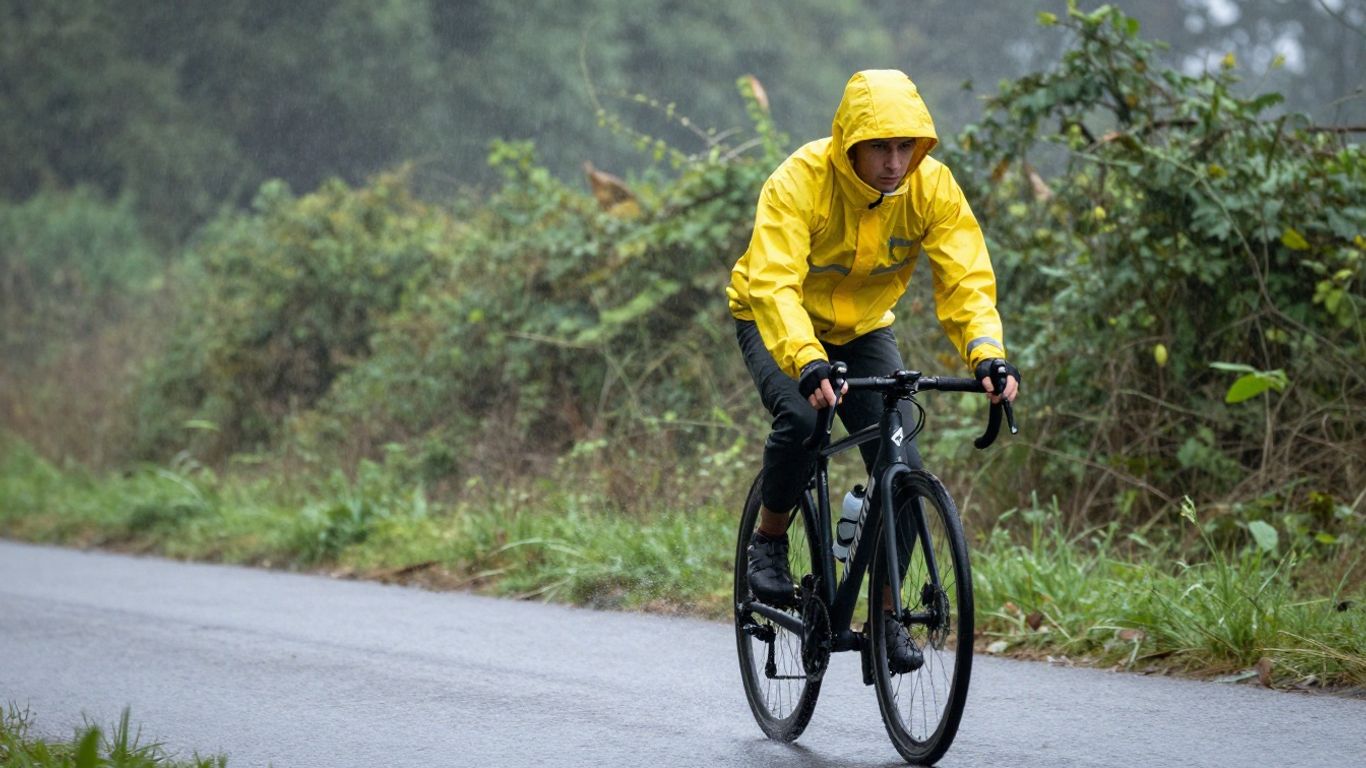
When it rains, it's often dim. Dark clothing quickly blends into the gray. That's why many cycling rain jackets are in bright colors. Reflective elements are also a must. They reflect the light from car headlights and make you more visible to other road users. This increases your safety, especially if you ride a lot in city traffic or in poor visibility.
-
Bright, eye-catching colors
-
Reflective details on sleeves, back, and chest
-
Some jackets even have integrated LED lights
Hood and Collar
The hood should fit well and be adjustable. It must protect you from rain, but must not obstruct your vision, especially when you turn your head. Some hoods can be adjusted to fit well with a helmet. A high collar also protects against wind and rain, especially if you are riding without a helmet. It should not be too tight so that you can move freely.
-
Adjustable hood for good fit and vision
-
High collar as additional weather protection
-
Check compatibility with bike helmet
Special Requirements for Different Cyclists
For road cyclists, every gram and every centimeter of storage space counts. A good rain jacket for this group is therefore extremely light and can be folded up tiny. It then fits easily into the back pocket of a jersey. The material is often thinner, but still waterproof. The cut is close-fitting to minimize air resistance. Unnecessary extras such as many pockets or a thick hood are usually omitted. The focus is clearly on weather protection when it unexpectedly gets wet, without affecting the riding experience.
Road Cyclists: Lightness and Pack Size
-
Extremely light: Every gram counts to not impair performance.
-
Minimal pack size: Fits in any jersey pocket or small saddlebag.
-
Close-fitting cut: Reduces wind resistance.
-
High waterproofness: Reliably protects against rain.
Mountain Bikers and Touring Cyclists: Robustness and Comfort
Those who ride mountain bikes or go on extended tours need a more robust jacket. These models are often a bit thicker and more resistant to abrasion, in case you ride through bushes. They offer more freedom of movement and are usually equipped with a well-adjustable hood that also fits over a helmet. Pockets for important utensils are standard here. Breathability is important, but perhaps not as extreme as with pure road cycling jackets, as the intensity of the ride can vary. Comfort and long-term protection are paramount.
-
Robust material: Withstands branches or falls.
-
Good ventilation: Prevents overheating during varying efforts.
-
Helmet-compatible hood: Offers additional protection.
-
Ample pockets: For tools, snacks, and phone.
Commuters: Durability and Weather Protection
For daily commuting or year-round cyclists, a durable and versatile rain jacket is crucial. These models are often cut longer to protect the back well even in a slightly hunched posture. They are usually cut a bit wider so that a warmer layer can fit underneath. Reflective elements are particularly important here for visibility in road traffic. The jackets are designed for permanent weather protection and often also feature an integrated hood in the collar. Robustness takes precedence over pure weight or pack size here.
Durability and good weather protection are essential for commuters. The jacket must withstand daily stresses and reliably keep you dry, so that the ride to work does not become a ordeal.
-
High durability: For daily use.
-
Good weather protection: Stays waterproof even in continuous rain.
-
High visibility: Reflective details for added safety.
-
Comfortable fit: Provides space for additional clothing layers.
Sustainability and Environmental Friendliness
Recycled Materials in Rain Jackets
More and more manufacturers are focusing on environmentally friendly materials. This is a good thing, because the production of outdoor clothing can harm the environment. An important step is the use of recycled materials.
Many jackets today are made from recycled polyester, often obtained from old PET bottles. This saves resources and reduces waste. Brands like Vaude show how this works. Their jackets often use Ceplex fabric made from recycled polyester. Impregnation is also increasingly being made PFC-free. This is important because PFCs (perfluorinated chemicals) are harmful to the environment and can accumulate in the soil. They are also known as "forever chemicals." GoreWear and Vaude, for example, already avoid PFAS in their products.
Durable and Repairable Models
A good rain jacket should not only be produced in an environmentally friendly way, but also last a long time. Durability is an important aspect of sustainability. If a jacket lasts for many years, it needs to be replaced less often. This saves resources and money. Look for high-quality workmanship. Sealed seams and robust zippers are a sign of quality. Some manufacturers also offer repair services.
This is great if something breaks. So the jacket can be repaired instead of thrown away. This protects the environment and your wallet. Models specially developed for mountain biking or for commuters are often particularly robust. They can withstand more and are therefore a good choice for anyone who spends a lot of time outdoors. A jacket that can be well maintained also lasts longer. The right cleaning and impregnation are crucial here.
Care and Maintenance of Your Rain Jacket
For your cycling rain jacket to function well for a long time and reliably protect you from wetness, proper care is crucial. This applies especially to the water-repellent impregnation and the breathability of the membrane.
Cleaning Membrane Jackets
How often you need to wash your jacket depends on the material and the type of dirt. In principle, the more often you wash the jacket, the more you stress the membrane and the impregnation. But especially with heavy use, sweat residues accumulate in the pores of the membrane. These can impair breathability. Microporous membranes, as are often installed in Gore-Tex or eVent jackets, should therefore be cleaned regularly to ensure moisture transport.
-
Detergent: Always use a special functional detergent. Conventional detergents or fabric softeners can damage the membrane and impair the impregnation.
-
Temperature: Wash the jacket at a maximum of 40 degrees Celsius. A spin cycle with a maximum of 400 revolutions protects the material.
-
Rinse: Rinse the jacket one or two times after the actual wash cycle to remove all detergent residues.
-
Drying: Avoid tumble drying, unless the manufacturer's instructions explicitly recommend it to reactivate the impregnation. Instead, hang the jacket to dry.
Impregnation for Long-lasting Protection
The water-repellent outer layer (DWR coating) of your rain jacket wears off over time. If water no longer beads off properly but is absorbed by the surface, it's time for new impregnation. A DWR coating usually only lasts a few washes, often only three to four. PFAS-free impregnations are usually a little less durable.
-
Reactivation: Often, it is enough to put the dry jacket in the tumble dryer for about 20 minutes at 60 degrees Celsius. This can reactivate the original impregnation.
-
Refreshment: If reactivation no longer helps, you should treat the jacket with an impregnation spray or agent. Make sure to apply the agent evenly to the dry outer shell.
-
Regularity: How often you need to re-impregnate depends heavily on usage. Simply observe how well the water beads off. With heavy use, this may be necessary after just a few weeks.
Proper care ensures that your rain jacket not only keeps you dry but also remains breathable. This is important so that you do not overheat while cycling and sweat is transported outwards. A well-maintained jacket lasts significantly longer and reliably protects you on every ride.
Practical Details and Accessories
Pockets for Smartphones and Small Items
When choosing the right rain jacket for cycling, pockets play an important role. They offer space for important things like your smartphone, keys, or a small snack. The position of the pockets is crucial. A chest pocket is often easily accessible, even while riding. Some jackets even offer pass-through options to jersey pockets, which is particularly practical for road cyclists. It is important that the pockets are securely closable and ideally waterproof to protect the contents from moisture. With very light jackets, you sometimes have to make compromises and settle for a single pocket.
-
Chest pockets: Easily accessible, often waterproof and closable.
-
Side pockets: Offer more space, but not always integrated.
-
Inner pockets: Protect contents from wind and weather, but less accessible.
-
Pass-throughs: Allow access to jersey pockets.
Combination with Rain Pants and Shoes
A good rain jacket is only one part of the equipment. To stay completely dry in heavy rain, combining it with suitable rain pants and waterproof shoe covers is advisable. The jacket should be cut long enough to connect well with the pants and prevent water from penetrating at the back. Make sure that the cuffs fit snugly with your gloves to keep your wrists dry. The hood also plays a role: it should fit well under or over your helmet without restricting your vision. Some models also offer special cuffs on the sleeves that provide additional protection against rain.
The right combination of jacket, pants, and shoe covers ensures that you stay dry and comfortable even on longer tours in adverse conditions. This not only increases the enjoyment of cycling, but also safety.
Conclusion: The Right Rain Jacket for Your Tour
So, at the end of the day, it's like many things: there isn't one perfect rain jacket for everyone. Whether you're a road cycling enthusiast who wants to carry only the essentials, a mountain biker who occasionally carries a backpack, or a commuter who has to get to work in all weathers – the requirements are simply different. Think about what you do most often.
Do you need something light for your jersey pocket or something more robust that can also handle a backpack? Pay attention to waterproofness, sure, but don't forget breathability. Otherwise, you'll end up wetter than if you hadn't worn anything at all. And hey, if you're clearly visible, that's also a big plus, especially when it's gray and gloomy again. So, choose the jacket that suits you and your tours, and then nothing will stand in the way of cycling fun in the rain!
Frequently Asked Questions
What should I look for when buying a rain jacket for cycling?
The most important thing is that the jacket keeps you dry but also allows air to pass through so you don't get wet from the inside. Think about what you need the jacket for: If you ride often and for long periods, you need something robust. For fast tours, a lightweight jacket that fits well in a pocket is better.
What do waterproofness and breathability mean?
Waterproof means no rain gets through the jacket. This is often indicated by a number (water column). Breathability means that sweat and moisture can escape from the inside out. This is important so that you don't overheat and get wet while riding.
Does a cycling rain jacket need a hood?
A hood is very practical for keeping your head and hair dry. Make sure the hood fits well and doesn't obstruct your vision, especially if you're wearing a helmet. Some jackets have a stowable hood in the collar.
Are colorful or reflective jackets better?
Yes, absolutely! When it rains, it's often darker. Bright colors and reflectors help motorists and other road users see you better. This makes your ride safer.
How do I best care for my cycling rain jacket?
Don't wash your jacket too often and use a special detergent for functional clothing. Afterwards, you should re-impregnate it so that it protects well against water again. Always read the care instructions on the label.
What is the difference between a rain jacket for road cyclists and for mountain bikers?
Road cycling jackets are usually very light and packable, so they fit into a jersey pocket. They often have a tight cut. Mountain bike jackets are more robust, sometimes a bit thicker, and offer more room if you are wearing a backpack.





Share:
This is what an outdoor backpack needs to be able to do!
Looking for a breathable rain jacket? Note this!