



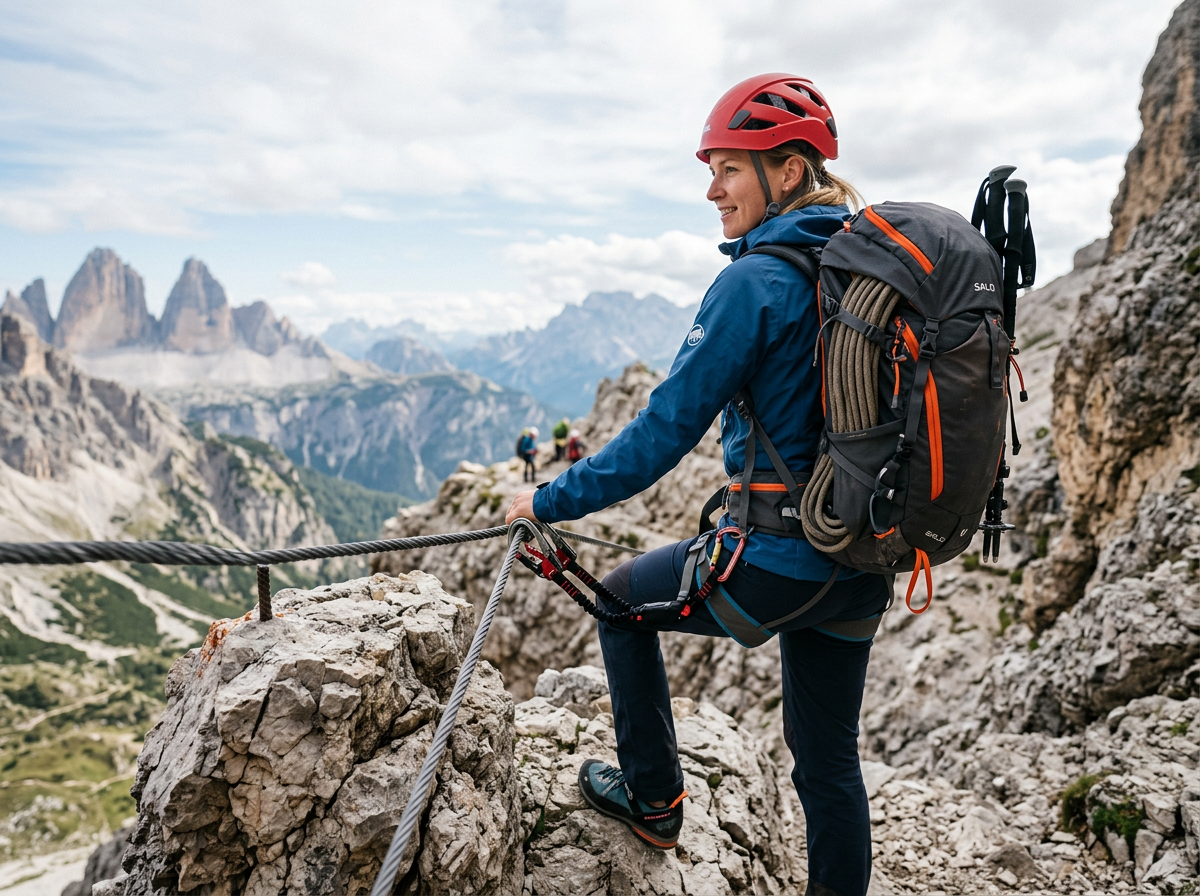


The Ideal Via Ferrata Backpack
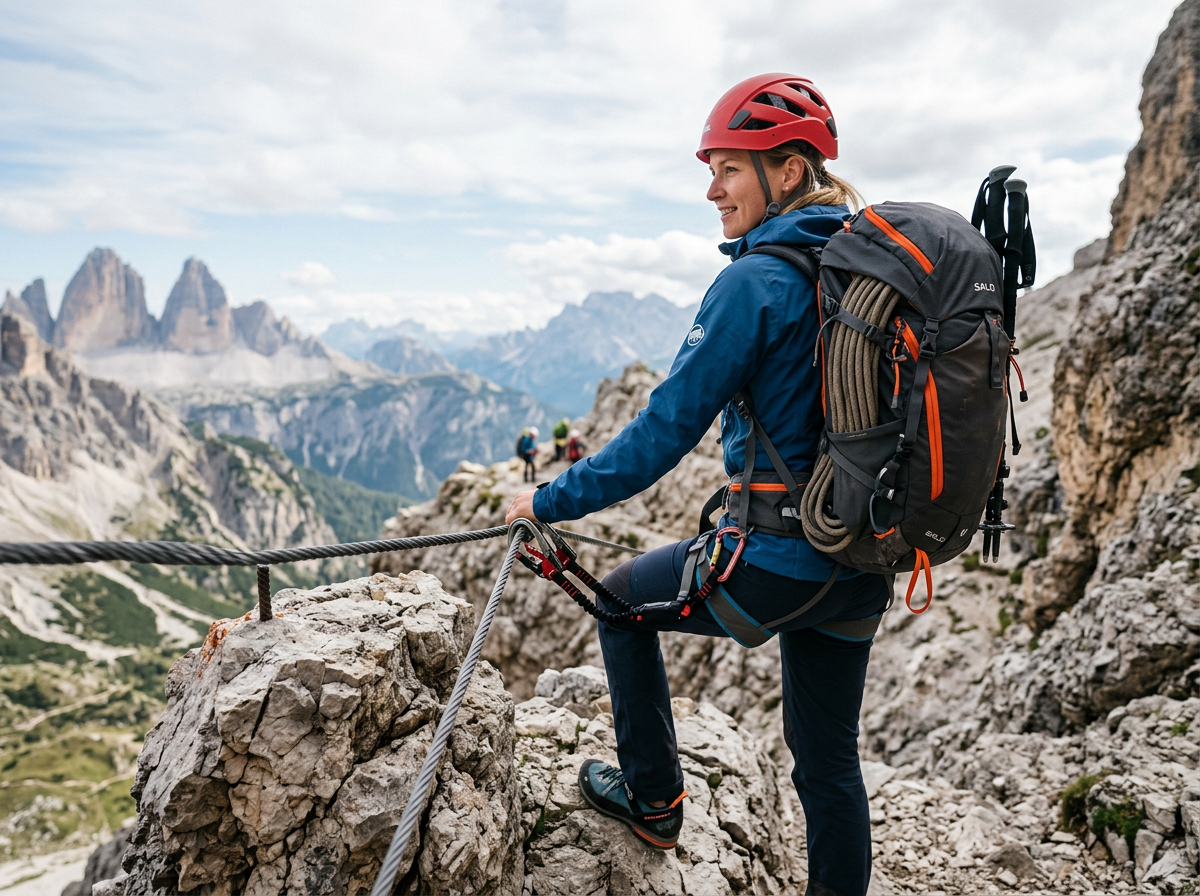
You're at the start. The rock calls! The steel cable gleams in the sun and your heart beats faster. Via ferrata is pure fascination! It's the perfect blend of hiking and climbing. But for this vertical adventure, you need the right gear. Your backpack is more than just a carrying sack. It's your trusty partner on the mountain! A good via ferrata backpack gives you freedom, safety, and comfort. Learn here what really matters!
Why is a normal hiking backpack unsuitable for the rock face?
The wrong center of gravity: When the backpack pulls you back
Your normal hiking backpack is great for long tours on moderate terrain. It distributes weight optimally for upright walking. But on a via ferrata, the world looks different!
Hiking backpacks often have a center of gravity that is further away from the back. This is comfortable for hiking. In the vertical, however, it becomes a burden.
The backpack pulls you backward. You constantly have to fight against this weight. This costs valuable energy!
Especially in overhanging or exposed areas, this can quickly become uncomfortable or even dangerous. Your balance is disturbed.
Too wide and bulky: When you get stuck in the wall
Hiking backpacks are often bulky and wide. They offer a lot of space. But that's exactly the problem on the rock face!
Imagine a narrow rock gully or a traverse close to the wall. A wide backpack gets snagged. You get caught.
Every unwanted contact with the rock disrupts your rhythm. It can throw you off balance. You definitely don't want that!
A via ferrata backpack is therefore extremely narrow and compactly built. It's like a second skin.
Lack of special features: Where does the helmet go?
A hiking backpack often has side mesh pockets for water bottles and a holder for trekking poles. That's usually it.
On a via ferrata, you need more! Where do you attach your helmet during the approach? Where do you put your via ferrata set when you don't need it?
A hiking backpack lacks the crucial details. No helmet holder. No robust gear loops for carabiners.
The material is often not designed for rough rock contact either. A quick tear in the fabric can abruptly end the tour.
What makes a close-fitting design so crucial for freedom of movement?
Full arm freedom for the next grip
On a via ferrata, you often have to reach high. Your arms need maximum freedom of movement. Nothing should restrict you!
Special alpine backpacks have narrowly cut shoulder straps. They are positioned so that your shoulder joints remain completely free.
You can lift your arms, stretch, and pull yourself to the next anchor point. Without the strap rubbing, pressing, or blocking.
This difference is huge! It determines fluid movements and pure enjoyment on the rock.
Absolute stability in every movement
Imagine you make a dynamic pull and your backpack swings from side to side. A terrible feeling!
A via ferrata backpack sits compactly and firmly on your back. It becomes part of your body. Nothing wobbles, nothing slips.
This is made possible by a close-fitting design and well-thought-out compression straps. With them, you pull the contents tightly together.
This keeps the center of gravity always close to your spine. You maintain full control over your balance.
Perfect harmony with the climbing harness
You wear a climbing harness on the via ferrata. Your backpack must not interfere with it in any way!
The hip belts of hiking backpacks are often wide and heavily padded. They would rest directly on your climbing harness. This is uncomfortable and unsafe!
Via ferrata backpacks therefore have a very minimalist hip belt. Often it is just a simple webbing strap.
On many models, you can even remove the hip belt completely. This way, access to your climbing harness's gear loops is always unobstructed.
At a glance
A via ferrata backpack is narrow, fits close to the body, and doesn't interfere with your climbing harness. It's your specialized partner for the vertical and ensures maximum freedom of movement and safety.
Which features are indispensable for a via ferrata backpack?
The helmet holder: Safely stowed, quickly at hand
Your helmet is your most important lifesaver on the mountain! But you don't always have to wear it on your head during the ascent and descent.
Just letting it dangle from your backpack is not a good idea. It dangles around and can get lost.
A good via ferrata backpack has an integrated helmet holder. This is usually an elastic net that is stretched over the helmet.
It holds the helmet securely and firmly on the backpack. Nothing gets in the way. And when you need it, it's immediately accessible.
Gear loops and Daisy Chains: Order and quick access
Carabiners, quickdraws, or your poles have to go somewhere. You need them quickly and without long searching.
That's what gear loops and so-called "Daisy Chains" are for. These are sewn-on webbing loops on the outside of the backpack.
Here you can easily hang equipment with a carabiner. Everything is tidy and immediately visible.
Folding poles for the approach often find a better hold here than in side pockets.
Access to the main compartment: Top-loader or front zipper?
How do you get to your stuff? There are two common systems. The classic top-loader has a lid flap.
Top-loaders are very robust and protect well from the weather. You can also clamp a jacket under the lid.
Backpacks with a long zipper on the front are becoming increasingly popular. You can open them like a sports bag.
This is extremely practical! You immediately find what you are looking for without having to empty the entire contents. This is brilliant especially for a short break on the rock.
Checklist: Your perfect via ferrata backpack
- ✓ Slim, tall shape that does not extend beyond the shoulders.
- ✓ Close-fitting with a stable carrying system.
- ✓ Removable or minimalist hip belt that does not interfere with the climbing harness.
- ✓ External attachment for helmet and poles.
- ✓ Robust, abrasion-resistant material for rock contact.
What volume is ideal for via ferrata tours?
Less is more: The principle for day trips
Forget huge backpacks! On a via ferrata, every gram and every centimeter counts. Minimalism is key!
For most day tours, a volume of 15 to 25 liters is completely sufficient. You'll be surprised how little you really need.
What needs to go in? Via ferrata set, harness, helmet (for the approach), a rain or insulation jacket, first-aid kit, water, and a few snacks. That fits!
A smaller backpack is lighter. It can be compressed better and offers even more freedom of movement. You are more agile and faster.
When you do need more space
There are exceptions. Are you planning a very long tour at high altitudes? Or a route with a glacier crossing?
Then you might need a little more space. Additional warm clothing, microspikes, or even crampons need to be stowed away.
For such alpine undertakings, a backpack with 28 to 35 liters can be useful. It offers the necessary reserves.
However, it is important here too: The backpack must still be slim and suitable for alpine sports. Not a classic trekking backpack!
Special graphic: important criteria
The backpack must be narrow and fit close to the body. Nothing should block your arms or your upward gaze.
Rock contact is guaranteed! The material must be abrasion-resistant to protect your equipment safely.
Why is a robust material so crucial?
Rock contact: Your backpack will have to suffer
On a via ferrata, it's unavoidable. You scrape along rock walls. You squeeze through narrow chimneys. You set the backpack down on rough ground.
A thin, light fabric would quickly wear through here. A hole in the backpack is more than just a cosmetic flaw.
Your expensive rain jacket could be damaged. Important small parts could fall out. The material is your protective shell!
That's why manufacturers of alpine backpacks rely on extremely durable fabrics. They are made for exactly this kind of stress.
A brief insight into material science
You often read specifications like "420D Ripstop Nylon" or "500D Cordura". What does that mean?
"D" stands for Denier. It is a unit for thread thickness. A higher number generally means a thicker, more tear-resistant yarn.
Ripstop fabrics have thicker threads woven in at regular intervals. This prevents a small tear from ripping further. A kind of built-in safety net!
Cordura is a brand name for a particularly robust polyamide fabric. It is considered extremely abrasion-resistant and durable.
Reinforcements in the right places
A good backpack is not equally thick everywhere. That would make it unnecessarily heavy. Smart construction is key!
Particularly stressed zones are specifically reinforced. This is especially true for the backpack bottom. It has the most contact with the ground and rock.
The front and sides are also often made of a more resistant material than the back area.
This combination of lighter and extremely robust fabrics creates the perfect compromise. Low weight with maximum durability! Your mountain-loving heart will love it!
Frequently asked questions
Can I also use a via ferrata backpack for sport climbing?
Yes, absolutely! The requirements are very similar. Climbing backpacks (often referred to as "Climbing Packs" or "Haulbags") are also narrow, robust, and designed for freedom of movement. Often they are even more minimalist and have fewer external pockets to completely rule out snagging on the rock. A good via ferrata backpack is therefore a great all-rounder for all vertical rock adventures!
How important is an integrated rain cover?
A rain cover is practical, but not as crucial on a via ferrata as it is for trekking. The tours are often shorter, and in uncertain weather, it's better to stay grounded. Furthermore, the robust materials of alpine backpacks are often heavily water-repellent coated. More importantly, you should pack clothes and electronics inside the backpack in waterproof dry bags. This saves weight and is often the more effective protection.
Are backpacks with zippers or with lids better?
Both have their fans! The classic lid backpack (top-loader) is extremely robust, offers excellent protection against rain, and you can clip a rope or jacket under the lid. Backpacks with a large front zipper (front-loader) offer unbeatable quick access to the entire contents. You don't have to rummage from the top. For via ferratas, where a quick break is important, front-loaders are often the more practical choice.
Do I need a hydration system preparation?
Absolutely! Regular drinking is extremely important on the mountain for your performance and concentration. On a via ferrata, you don't have a hand free to grab a bottle from your backpack. Preparation for a hydration system with a hose outlet on the shoulder straps is therefore a must. This way, you can drink at any time without having to stop or take off your backpack. Safe and comfortable!
What is the difference to an alpine backpack?
The lines are blurred, and many models are suitable for both. A pure alpine backpack is often even more minimalist and lighter. It has special holders for ice axes or a ski attachment. A via ferrata backpack sometimes focuses a bit more on comfort and organization, for example, through a front zipper. Basically, however, both types of backpacks are trimmed to the core points: robustness, narrow shape, and freedom of movement.













Share:
Should merino be tight or not?
How to avoid sweating when hiking?