



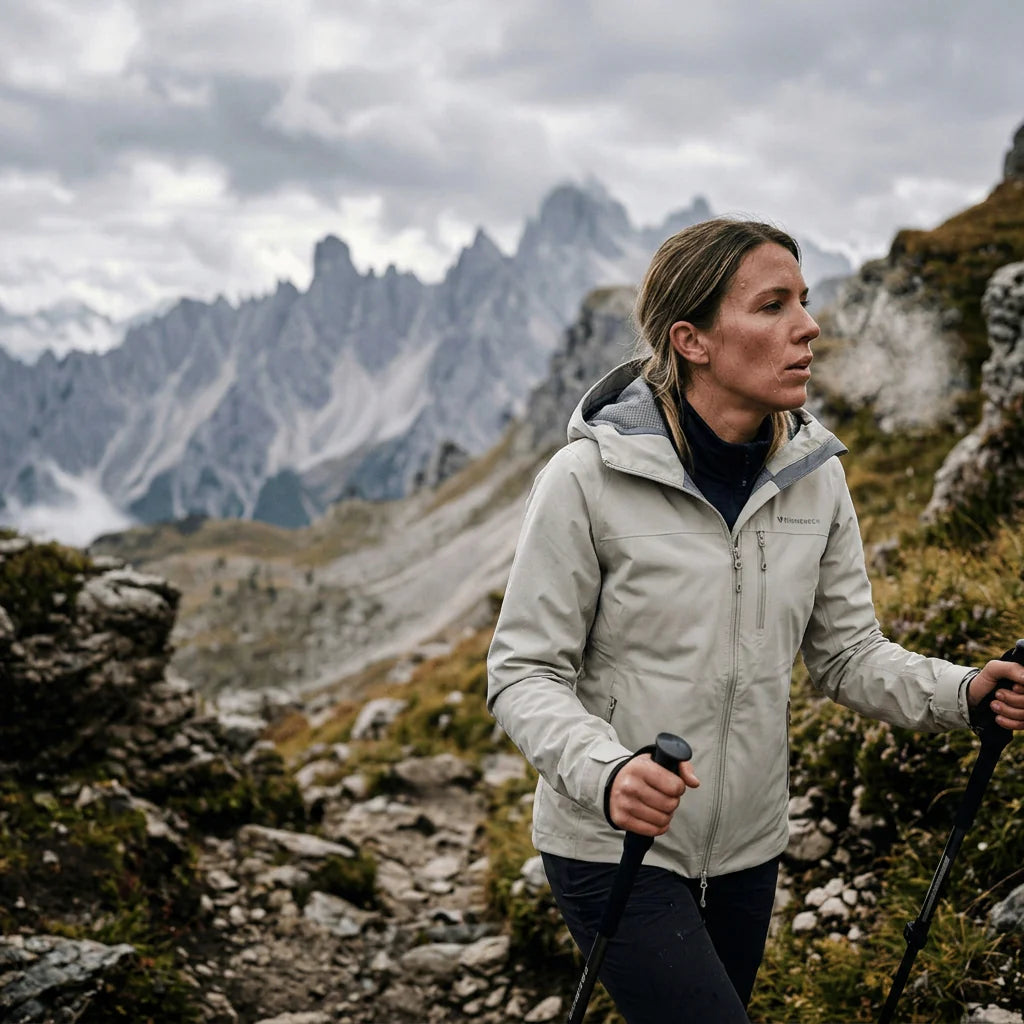


Breathability: What RET & MVTR Values in Jackets Mean
⏱ Reading time: approx. 20 min.
Breathability is crucial in outdoor clothing to maintain a comfortable body climate. But how is this property really measured? Many manufacturers advertise with various values, but not all of them are self-explanatory.
Imagine you're on a challenging hike and your jacket keeps the rain out, but you're sweating profusely from the inside. This is the moment when your jacket's breathability has failed. A common problem that quickly dampens the fun of being outdoors.
This is precisely where RET and MVTR values come in. They provide clear guidance on how well a jacket can transport moisture from the inside to the outside. With this knowledge, you can make a much better purchase decision and stay dry and comfortable during any activity.
In a Nutshell
- RET values measure the resistance to evaporative heat transfer of textiles.
- MVTR values indicate the moisture vapor transmission rate in grams per square meter per 24 hours.
- Low RET values and high MVTR values mean better breathability.
- The choice of the appropriate value depends on the intensity of your activity.
What do RET values mean for outdoor jackets?
The RET value, short for "Resistance to Evaporative Heat Transfer," measures a material's resistance to the passage of water vapor. This value quantifies how well a fabric wicks away the moisture produced by your body – i.e., sweat – to the outside, without moisture accumulating inside. A low RET value indicates higher breathability and thus better wearing comfort.
Imagine you're on a demanding mountain tour. Your body produces a lot of sweat. A jacket with a low RET value allows this water vapor to escape effectively, so you stay dry from the inside. Jackets with an RET value below 6 are considered extremely breathable, ideal for high-intensity activities like trail running or ski touring. Values between 6 and 13 are very good for moderate exercise.
The RET value is measured according to ISO standard 11092. This involves a test procedure that determines the amount of water vapor escaping through a textile sample. This is done under controlled conditions to ensure standardized comparability. This method is widely used in the textile industry and provides a reliable metric.
Understanding the RET value scale
RET values are not just numbers; they form a clear scale that helps you accurately assess a jacket's breathability. The smaller the number, the better the performance. A jacket with an RET value of under 6 is designed for extreme exertion, such as climbing or very fast hiking.
For everyday outdoor activities or hikes of moderate intensity, jackets with an RET value between 6 and 13 are perfectly sufficient. They offer a good compromise between weather protection and breathability. Values above 20, however, indicate low breathability and are more suitable for static activities or very cold, dry conditions.
For example: a hardshell jacket designed for high-altitude tours should have an RET value of maximum 8. A simple rain jacket for urban use, on the other hand, can have a value of 15 or higher, as the demands on sweat transport are lower here.
Influence of material and membrane on the RET value
The material and membrane of a jacket significantly influence the RET value. Modern membranes such as polyurethane (PU) or ePTFE (expanded polytetrafluoroethylene) are crucial for breathability. These membranes have microscopically small pores that allow water vapor molecules to escape but keep water droplets out from the outside.
Some manufacturers also use special hybrid constructions, combining different membranes or fabrics to optimize breathability in specific zones. For example, a jacket might have a membrane with a lower RET value in the back area, while other areas are designed for greater robustness. The type of fabric construction, such as thread density or weave, also plays a role. A more densely woven material often has higher resistance to water vapor, which increases the RET value.
Practical Tip
When buying, don't just pay attention to the RET value, but also to the seam construction. Fully taped seams are essential to truly guarantee the advertised breathability and waterproofing. High breathability is of little use if water penetrates through the seams.
What do MVTR values mean for functional jackets?
The MVTR value, or "Moisture Vapor Transmission Rate," indicates how much water vapor diffuses through a square meter of fabric within 24 hours. This value is expressed in grams per square meter per 24 hours (g/m²/24h). Unlike the RET value, where a lower value is better, here: The higher the MVTR value, the more breathable the jacket. It thus directly describes the amount of moisture that can escape.
An MVTR value of 10,000 g/m²/24h means that 10 kilograms of water vapor per square meter of fabric can escape within one day. For light to moderate activities, values of 10,000 g/m²/24h and above are recommended. For more intense sports such as mountain running or ski touring, you should consider jackets with MVTR values of 20,000 g/m²/24h and more. These high values guarantee that your body remains dry even during strenuous activity.
The MVTR value is measured according to various standards, such as ASTM E96 or JIS L 1099. These methods vary slightly in test conditions, which can lead to different results. Therefore, it is important to compare MVTR values directly only if they have been determined according to the same test standard. Often, manufacturers use the JIS L 1099 B-1 method, which is considered standard in the industry.
MVTR measurement methods and their significance
There are various methods for determining the MVTR value, which can lead to different results. The Upright Cup Method (ASTM E96) measures moisture emission at a specific temperature and humidity. Here, the material is stretched over a container of water, and the weight loss of the water is recorded over a 24-hour period.
Another common method is the Inverted Cup Method, also according to ASTM E96, which is better suited for waterproof materials. The Japanese standard JIS L 1099 B-1 is particularly popular because it often yields higher values and is therefore preferred by marketing departments. This method uses a calcium chloride container that absorbs moisture and measures the change in weight. It is crucial that when comparing jackets, you always pay attention to which standard the MVTR value was determined, so as not to compare apples and oranges.
A high MVTR value of 30,000 g/m²/24h according to JIS L 1099 B-1 may correspond to a value of only 15,000 g/m²/24h according to ASTM E96. This discrepancy illustrates the importance of knowing the measurement method. Without this information, a direct comparison is hardly possible and can lead to misinterpretations. Therefore, pay attention to the indication of the test standard.
Optimal MVTR values for various activities
The choice of the optimal MVTR value depends heavily on the planned activity. For leisurely walks or everyday use in light rain, MVTR values of 5,000 to 10,000 g/m²/24h are often sufficient. Here, weather protection is often paramount, and sweat production is low.
For more demanding hikes, trekking tours, or skiing, values of 15,000 to 20,000 g/m²/24h are ideal. These jackets offer a good compromise between breathability and waterproofing, ensuring you stay dry even with moderate exertion. For high-intensity sports such as trail running, mountain biking, or fast ski tours, you should choose jackets with MVTR values of over 20,000 g/m²/24h. These materials are designed to quickly wick away maximum moisture and prevent overheating.
A practical example: a jacket with an MVTR value of 25,000 g/m²/24h is much better suited for a marathon runner in the rain than a jacket with 8,000 g/m²/24h, as the runner has significantly higher sweat production. The correct adjustment of the MVTR value to the individual activity prevents heat build-up and ensures a comfortable wearing experience.
RET vs. MVTR: Which value is more significant?
Both RET and MVTR values attempt to quantify the breathability of textiles, but they do so in different ways. The RET value measures resistance to water vapor, while the MVTR value measures the amount of water vapor that penetrates. One could say RET is a resistance value and MVTR is a transmission value. A low RET value indicates high breathability, while a high MVTR value also indicates high breathability.
The ISO standard 11092, used for RET values, is widely adopted in Europe and considered very reliable. It simulates the conditions that arise when wearing clothing by measuring thermal conductivity and resistance to water vapor transfer under controlled conditions. MVTR values, on the other hand, as already mentioned, can vary greatly depending on the measurement method. This often makes direct comparison of MVTR values from different manufacturers difficult and less precise.
For the end consumer, the RET value is often the more reliable indicator, as it has a more consistent measurement basis. So, if you are comparing two jackets and both provide an RET value, you can assume that these values are directly comparable. For MVTR values, you should always pay attention to the specified test standard to make a meaningful assessment. Without this information, the MVTR value is less informative.
Why different measurement methods exist
The existence of different measurement methods for breathability has historical and geographical reasons. Various countries and industries have developed their own standards that meet specific requirements and technologies. ASTM standards (American Society for Testing and Materials) are prevalent in North America, while ISO standards (International Organization for Standardization) are applied worldwide, especially in Europe.
Test conditions also play a role. Some methods, for example, simulate higher wind speeds or greater temperature differences to test performance under extreme conditions. This means that the same material can have different values depending on the test method. Another factor is the effort and cost of measurement. Some methods are more complex and expensive to perform, which can influence manufacturers' choices.
For you as a consumer, this means that you should always pay attention to the reference standard when researching. Only then can you ensure that you obtain comparable data. Without this information, the numbers are only of limited significance and can easily lead to incorrect conclusions. Understanding the measurement methods enables a more informed purchasing decision.
Practical examples for comparison
Let's say you're choosing between two jackets. Jacket A has an RET value of 8, and Jacket B has an MVTR value of 20,000 g/m²/24h (JIS L 1099 B-1). Without further information, a direct comparison is difficult. However, if Jacket A also specifies an MVTR value of 15,000 g/m²/24h (JIS L 1099 B-1), you can see that Jacket B is more breathable.
Another example: A jacket with an RET value of under 6 is ideal for a marathon run in the rain. It transports sweat extremely efficiently. For a leisurely autumn hike with the family, a jacket with an RET value of 10 to 13 is perfectly sufficient. Here, the need for maximum breathability is lower, and the focus is more on comfort and protection from light rain.
Combining both values can give you an even more comprehensive picture. If a manufacturer provides both RET and MVTR, use this information to better understand the material's performance. This way, you can make an informed decision that perfectly matches your outdoor activities and offers you maximum comfort.
In short: RET values are often more reliable and easier to compare in Europe, as they are based on a uniform standard, whereas MVTR values can vary depending on the test method.
What other factors influence breathability?
The pure RET and MVTR values are important indicators, but they don't tell the whole story. The actual breathability of a jacket is influenced by other factors that you should definitely consider. These include environmental conditions, your activity level, and the fit of the jacket. A high MVTR value is of little use if external conditions hinder moisture transport.
Humidity plays a crucial role. At high external humidity, the vapor pressure difference between the inside and outside is smaller. This means that less water vapor can diffuse from the inside to the outside, even with a jacket with excellent values. Temperature also affects breathability. In cooler temperatures, the jacket can work more effectively, as the temperature gradient promotes moisture transport. A jacket that works excellently at 10 °C can reach its limits at 25 °C and high humidity.
Your individual metabolism and activity level are also decisive. A person who sweats quickly and heavily needs a jacket with significantly higher breathability than someone who sweats only lightly. The intensity of movement generates different amounts of body heat and sweat that need to be wicked away. A jacket designed for a leisurely hike will quickly be overwhelmed during a trail running competition.
The role of environmental conditions
Imagine you're trekking through a tropical rainforest. The humidity is extremely high, almost 100 percent. Even the most breathable jacket with an RET value of 5 will reach its limits here. The reason is the low vapor pressure gradient. Water vapor always moves from an area of higher vapor pressure to an area of lower vapor pressure. If the outside air is already saturated with moisture, your body's sweat can barely escape.
In the mountains, however, with cool, dry air, a jacket can unleash its full potential. Here, the vapor pressure difference is large, and water vapor is efficiently wicked away. Wind speed is another factor. Light wind can even improve breathability by carrying moist air away from the jacket's surface. However, too strong a wind can amplify the cooling effect and impair insulation performance.
It is therefore important to always consider the specified RET and MVTR values in the context of typical operating conditions. A jacket that performs exceptionally well in Scandinavia might be less convincing in Southeast Asia. The best jackets are often those that offer a balance between breathability and weather protection for the specific climatic conditions in which you will primarily use them.
Activity Level and Clothing Layers
Your activity level is probably the most important factor for the required breathability. A high heart rate and intense muscle work lead to an increased body temperature and thus more sweat production. For such scenarios, you need jackets with the best RET and MVTR values. For less strenuous activities, such as a leisurely stroll, the demands on sweat transport are significantly lower.
The clothing layers under your jacket also play a role. The so-called onion principle is crucial here. A moisture-wicking base layer (e.g., made of merino wool or synthetic fibers) transports sweat away from the skin to the next layer. An insulating mid-layer (e.g., fleece) keeps you warm and continues to wick moisture. The outer layer, your hardshell jacket, must then release the remaining water vapor to the outside.
If the underlying layers do not effectively wick away sweat, moisture can accumulate, even if your jacket is theoretically very breathable. So make sure that all layers of your clothing system are coordinated. Only then can the entire system function optimally and keep you dry and comfortable.
Which option fits?
For High-Performance Athletes
Choose jackets with RET values below 6 and MVTR values above 25,000 g/m²/24h to ensure maximum sweat wicking.
For Moderate Outdoor Activities
Jackets with RET values between 6 and 13 or MVTR values from 10,000 to 20,000 g/m²/24h offer optimal comfort here.
Care and Longevity of Breathability
Even the most breathable jacket will lose its function if not properly cared for. Dirt, skin oils, and detergent residues can clog the pores of the membrane, significantly reducing water vapor transport. Regular and correct care is therefore crucial for the longevity of your jacket's breathability.
Always use special detergents for functional clothing. These are designed not to damage the membranes and to avoid residues. Conventional detergents often contain fabric softeners or fragrances that can stick to the fine pores of the membrane. Do not wash your jacket too hot and spin it only lightly. After washing, it is often advisable to refresh the water-repellent impregnation (DWR – Durable Water Repellent), as it wears off over time.
The DWR coating ensures that water droplets bead up on the surface and do not penetrate the fabric. If this layer is damaged, the outer material soaks up water, which is called "wet-out." While this does not directly affect the breathability of the membrane, the fabric feels wet and cools down. In addition, the soaked surface makes it more difficult for water vapor to pass from the inside out. An intact DWR layer is therefore essential for the overall performance of your jacket.
Proper Washing of Functional Jackets
Properly washing your functional jacket is not witchcraft, but it does require a few special steps. First, you should close all zippers and fasten Velcro closures to prevent damage. Turn the jacket inside out to protect the membrane. Use a liquid special detergent for functional clothing, as powder detergents can leave residues.
Choose a gentle wash cycle at a low temperature, usually 30°C or 40°C, and a low spin speed. Absolutely avoid fabric softeners, bleach, and chemical cleaners, as these can permanently damage the membrane. After washing, it is important to rinse the jacket thoroughly to remove all detergent residues. Sometimes an extra rinse cycle is useful.
It is best to air dry the jacket or tumble dry it at a low temperature on a delicate cycle. The heat in the dryer can even help reactivate the DWR impregnation. Always follow the manufacturer's care instructions found on your jacket's label. Careful care extends the life of your jacket and maintains its full function.
Important to know
A common misconception is that functional jackets should be washed infrequently to protect the membrane. In fact, the opposite is true: regular washing removes dirt and skin oils that clog pores and reduce breathability. It's better to wash your jacket more often and correctly than to clean it rarely and incorrectly.
Reactivating the Impregnation
The DWR impregnation of your jacket will wear off over time, even with the best care. You'll notice this when water droplets no longer bead up, but instead the fabric soaks through. This is the time to reactivate or renew the impregnation. Many DWR coatings can be reactivated by applying heat. Place your clean, dry jacket in a tumble dryer for about 20 minutes at a low temperature, or carefully iron it on the lowest setting without steam, with a cloth in between.
If reactivation is not enough, the impregnation must be renewed. There are special spray-on or wash-in products for this. Spray impregnations are often more effective because they only treat the outside of the fabric and do not affect the membrane from the inside. Make sure to apply the impregnating agent evenly and then dry the jacket to fix the effect.
Renewing the impregnation is an important step to maintain the full functionality of your jacket. A well-impregnated jacket not only protects you better from wetness but also supports the breathability of the membrane by preventing "wet-out". This way, you will always stay dry and comfortable on your outdoor adventures.
Rating at a Glance
Sustainability and Environmental Aspects of Functional Materials
The production of functional materials like breathable membranes often involves significant resource consumption and environmental impact. Many of these materials are based on plastics, whose production is energy-intensive. The use of fluorocarbons (PFCs) in DWR coatings is a particularly controversial topic, as these chemicals are persistent and can accumulate in the environment.
Fortunately, there are increasing efforts to develop more sustainable alternatives. Many manufacturers now use PFC-free impregnations, which are based on other chemical compounds and are less harmful to the environment. The use of recycled materials, such as recycled polyester or nylon, is also increasing. This reduces the need for new raw materials and lowers the ecological footprint of the products.
Some brands even go so far as to establish closed production cycles to minimize waste and use resources more efficiently. Bluesign certification is an example of a standard that promotes environmentally friendly production processes and the use of safe chemicals in the textile industry. When buying your next functional jacket, look for such certifications to contribute to environmental protection.
PFC-Free Impregnations: An Environmentally Friendly Choice
PFCs are chemical compounds traditionally used in DWR coatings to repel water and dirt. They are extremely effective but also environmentally harmful. PFCs are long-lasting, accumulate in the environment and living organisms, and can be detrimental to health. For this reason, many manufacturers are looking for alternatives.
PFC-free impregnations are often based on dendrimers, polyurethane, or paraffin waxes. While these alternatives may sometimes not be as durable in their water-repellent effect as PFC-containing coatings, they are significantly more environmentally friendly. However, developments in this area are progressing rapidly, and the performance of PFC-free products is constantly improving.
If you value sustainability, you should specifically look for jackets with PFC-free DWR coatings. Many outdoor brands now label their products accordingly. This is an important step to minimize the environmental impact of your outdoor gear without having to sacrifice functionality. Conscious consumption contributes significantly to the protection of our nature.
Recycled Materials and Circular Economy
The use of recycled materials is another important aspect of sustainability in the outdoor industry. Many functional jackets today are made from recycled polyester or nylon, often obtained from PET bottles or fishing nets. This not only reduces the consumption of fossil raw materials but also the energy consumption and emissions during production.
The circular economy goes a step further. Here, products are designed so that they can be returned to the production cycle at the end of their life. This means that materials are recycled and processed into new products instead of ending up in landfills. Some manufacturers even offer take-back programs for old products to allow for material recovery.
These approaches are crucial to reduce the ecological footprint of the outdoor industry. By choosing products made from recycled materials or from brands committed to the circular economy, you support a more sustainable future. It is an investment that pays off not only for you but also for our planet.
In short: The choice of PFC-free impregnations and recycled materials significantly reduces the environmental impact of functional jackets and promotes a more sustainable outdoor industry.
Frequently Asked Questions
Conclusion on choosing the optimal jacket
The decision for the right outdoor jacket depends on many factors, but understanding RET and MVTR values is a crucial step towards more comfort and functionality. These metrics provide an objective basis for comparing the breathability of different models. Don't forget that the RET value measures resistance and the MVTR value measures permeability – the lower the RET, the better; the higher the MVTR, the better.
Always keep in mind that the numbers alone are not everything. Your individual activity level, the prevailing environmental conditions, and the quality of your other clothing layers play just as big a role. A jacket with excellent values can still reach its limits with incorrect base layers or extremely high humidity. Therefore, always choose your jacket to suit your personal requirements and the intended area of use.
Also invest in the correct care of your functional jacket. Regular washing with special detergents and refreshing the DWR impregnation maintain breathability and extend the lifespan of your gear. Also pay attention to sustainable aspects such as PFC-free coatings and recycled materials to make a positive contribution to environmental protection. This way, you make a thoroughly smart decision for your next outdoor adventure.







Share:
Hut Hiking with Kids - The Best Tips!
What makes merino clothing so special?