



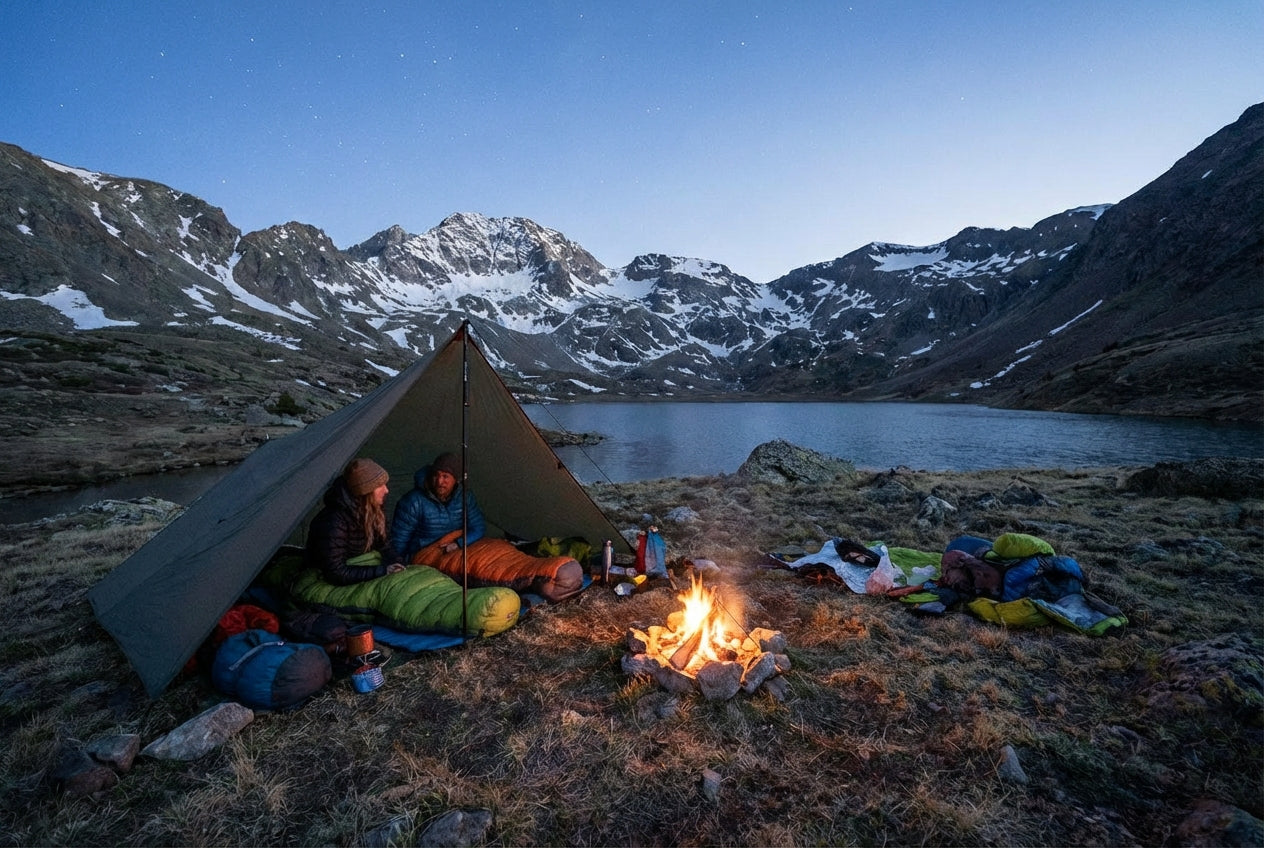
Bivouacking – it sounds like freedom and adventure, doesn't it? Simply sleeping outdoors with just the bare essentials. But what does it actually mean, and how does it differ from traditional camping?
We'll clarify what bivouacking really is, when it's a good idea, and what you need for it. We'll also talk about safety and the rules you should know. Because even when it comes to minimalism, preparation is key.
'

Wundervolle Sherpa Fleece Jacken | Praktisch und stylish!
Hier geht es zu unseren Sherpa Fleece Highlights
What does bivouacking really mean?
Bivouacking is essentially the simplest form of overnighting in nature. Imagine sleeping outdoors, but without a tent. Just you, your sleeping bag, and perhaps a special bivy sack to protect you from wind and moisture. It's about experiencing nature up close, without any frills. No tent pitching, no fixed paths. Just the elements and you.
The basic idea of bivouacking
The core idea behind bivouacking is minimalism. It's about getting by with the bare necessities and experiencing nature as unadulterated as possible. This means sacrificing comfort for a more intense nature experience. You are directly exposed to nature, hearing the sounds, feeling the air. It's a return to the essentials and a way to test your own resilience. You learn what you truly need and how little that often is.
Bivouacking is more than just sleeping outdoors. It's a conscious decision to leave your comfort zone and immerse yourself in a purist nature experience. It's about intensely perceiving your surroundings and feeling your connection to nature.
Bivouacking as a purist nature experience
When you bivouac, you become one with your surroundings. You wake up with the first light, hear the birds chirping, and feel the morning air. It's a feeling of freedom and adventure that you don't get when camping at a campsite. You're not separated from nature by walls; you're right in the middle of it. This can be a very enriching experience that shows you how little you need to be happy.
Distinction from wild camping
Bivouacking is not the same as wild camping. The main difference lies in the extent of the infrastructure. Bivouacking typically involves only a bivy sack or, at most, a small tarp. No permanent shelter is set up to remain overnight. The goal is often to spend just one night in a place and move on the next day. Wild camping, on the other hand, often implies setting up a full-fledged tent, which is more strictly regulated in many regions. Bivouacking is often considered less invasive and is therefore more tolerated or permitted in some areas than camping.
-
Bivy sack: Only the essential cover for your sleeping bag and you.
-
Tarp (optional): A small sheet for additional weather protection.
-
No tent: The absence of a tent is the core feature.
-
Minimal footprint: The goal is to leave almost no trace.
When is bivouacking the right choice?
For multi-day tours without infrastructure
Bivouacking is a good option when you're on longer tours and there's no fixed accommodation or designated campsites nearby. It allows you to remain flexible and spend the night wherever it suits you.
This is particularly advantageous in remote areas or on routes with little infrastructure. You are not tied to fixed locations and can plan your route more freely. This saves time and allows for a more intense nature experience.
When minimalism and adventure are desired
For those who like to travel light and seek the charm of simplicity, bivouacking is the perfect complement. It's about getting by with the bare essentials and experiencing nature up close.
This is a great way to step out of your comfort zone and develop a true sense of adventure. It's a conscious decision for less gear and more nature experience. This can be an enriching experience that teaches you to be content with less.
As an emergency solution for sudden weather changes
A bivy sack can also serve as important emergency equipment. If you are unexpectedly caught in bad weather, it provides basic protection against hypothermia and moisture. Especially in the mountains, weather conditions can change quickly. A lightweight emergency bivy sack in your backpack can be crucial in such situations to get through the night safely or to wait for rescue. It is small and light, but in an emergency, it can save lives. It's always good to be prepared for such eventualities, even if you don't plan to stay overnight.
Equipment for your bivouac
When you sleep outdoors, there's no retreat, no solid ground, and no plan B if it rains – that's why the right equipment is especially important when bivouacking. It's not about high-end gadgets, but about being light, functional, and weatherproof. What you really need depends heavily on where you are – and whether the bivouac is planned or more of an emergency solution.
The indispensable bivy sack
The bivy sack is the heart of bivouac equipment. It is essentially a windproof and waterproof sack that is pulled over the sleeping bag like a cover. Its main task is to protect you and your sleeping bag from moisture, wind, and dirt. This makes an overnight stay outdoors possible even without a tent. There are various models; some are breathable, some waterproof, and some both. If you plan to bivouac more often, you shouldn't skimp here. Cheap versions can often produce more condensation than they offer protection.
Sleeping bag and sleeping pad for comfort
Whether you have a restful night or wake up shivering at dawn often depends on exactly three things: the bivy sack, the sleeping bag, and the sleeping pad. The sleeping pad is indispensable, even in summer. The ground draws away heat – and anyone who has ever tried to sleep on cold, damp ground without a pad knows: it's no fun. The sleeping bag should be adapted to the season. In summer, a light summer sleeping bag is often sufficient, but in the mountains or in spring, you should rather have a warm, easily compressible sleeping bag with you.
The emergency bivy sack as a lifesaver
In addition to the classic bivy sack, there are also special emergency bivy sacks. These are often even lighter and more compact and are primarily designed to quickly provide protection against hypothermia in an emergency. They are usually made of a reflective material that retains body heat and simultaneously helps to make the person more visible in an emergency. While they don't replace a full-fledged bivy sack for planned tours, they can be carried in a backpack as an additional safety measure. Especially on tours where an overnight stay is not expected but the weather can change, such an item is invaluable.
In addition to these core items, weatherproof clothing, a headlamp, a small first-aid kit, and sufficient water and provisions are also important. Every gram counts, but these things make the difference between adventure and frustration.
Safety and responsibility when bivouacking
Bivouacking means experiencing nature up close. But that also brings risks. Without solid shelter, you are directly exposed to the elements. Therefore, it is important not only to focus on the adventure but also on your own safety and respect for the environment.
Weather, wildlife, and orientation
Nature is unpredictable. Especially when bivouacking, you should prepare for potential dangers. The weather can change quickly, even if the forecast is good. Sudden rain, storms, or strong temperature fluctuations are not uncommon. A bivy sack protects, but it's not a panacea. Inform yourself about local weather phenomena and observe the sky.
Wild animals in Europe are usually not a great danger, but curious animals like foxes or martens can appear at night. Always store food well packaged and not directly next to your sleeping place. This prevents unwanted visits.
If you are bivouacking off marked trails, orientation is crucial. Map, compass, or GPS are mandatory. This is important if you need to call for help in an emergency or want to find your way back.
Recognize risks and be prepared
A bivouac site must not only be beautiful but also safe. Pay attention to:
-
Evenness and stability: Avoid steep slopes or loose scree fields.
-
Water drainage: Do not sleep in depressions where water could collect.
-
Wind protection: Look for natural windbreaks, for example behind rocks.
-
Distance: Keep your distance from paths and huts so as not to disturb others.
-
Hazard zones: Avoid cliff edges, avalanche chutes, or unstable slopes.
Even in spring or autumn, snow remnants can be dangerous. Check the snow situation, especially in alpine regions.
A bivouac can become uncomfortable. It can be wet, cold, or noisy. But with the right knowledge and appropriate equipment, it becomes an unforgettable experience. It's about working with the conditions and accepting nature as it is.
Respectful interaction with nature
Bivouacking means avoiding leaving traces. This specifically means:
-
No fires: Only in officially designated areas, if permitted at all.
-
Leave no trace: Take everything with you, including organic waste.
-
No permanent camp: After one night, you move on or use official sites.
In many regions, bivouacking above the tree line is permitted under certain conditions, as long as it is a single overnight stay without a tent. However, this does not mean that you can rely on it. Always inform yourself about local rules. Those who sleep in the mountains take responsibility for themselves, nature, and other people.
Legal aspects of bivouacking
The legal situation regarding bivouacking is not uniformly regulated. It differs greatly from region to region and from country to country. What is tolerated in the mountains may already be forbidden in the forest. In general, always inform yourself in advance about local regulations. This saves trouble and fines.
Differences depending on region and country
In Germany, the situation is often unclear. There is no nationwide uniform law. The rules are a matter for the states and depend heavily on the respective area. Nature reserves and national parks are usually taboo. Overnight stays in forests can also be prohibited unless you have a permit. On private property, you always need the owner's permission.
In Switzerland, bivouacking above the tree line is often permitted, as long as no disturbance is caused and no litter is left behind. But even here there are exceptions, especially in protected areas. Austria, on the other hand, has stricter rules. Planned bivouacking is often prohibited; only emergency bivouacs are usually tolerated. In Southern Europe, such as France, Spain, or Italy, the rules are also often restrictive. Sometimes there are time windows when bivouacking is allowed, but caution is also advised here.
Emergency bivouac vs. planned bivouac
An important distinction exists between an emergency bivouac and a planned bivouac. An emergency bivouac is an overnight stay that becomes necessary due to unforeseen circumstances. These include sudden weather changes, injuries, or getting lost in the dark. Such emergencies are tolerated in most regions, even if bivouacking would otherwise be forbidden there. It is seen as a form of self-protection.
A planned bivouac, on the other hand, is a conscious decision to spend the night outdoors because one seeks the nature experience. This planned bivouacking is often legally equated with camping. This means that it is forbidden in many areas, especially in protected areas. The tolerance for a planned bivouac is significantly lower than for an emergency situation. So, if you deliberately want to spend the night outdoors, you must find out exactly if and where it is allowed.
Where bivouacking is allowed or tolerated
The question of where bivouacking is allowed or at least tolerated cannot be answered generally. Basically, the further away from civilization and human settlements, the more likely it is to be tolerated. Alpine regions above the tree line are often a good starting point, but even here there are restrictions.
-
Trekking sites: Some regions offer special trekking sites. These are legal, close to nature, and often equipped with basic infrastructure. Here you can bivouac without worry.
-
Alpine region (Switzerland): Above the tree line, it is often permitted as long as you leave no litter and cause no disturbance.
-
Emergencies: As already mentioned, emergency bivouacs are almost everywhere permitted if they are truly necessary.
What you should avoid are:
-
Nature reserves and national parks
-
Private property without permission
-
Places where a ban is explicitly signposted
-
Proximity to settlements or agricultural areas
When in doubt, it is always advisable to inquire with local authorities, tourist associations, or alpine clubs. This way you are on the safe side and can enjoy your nature experience without worries.
Bivouacking compared to camping
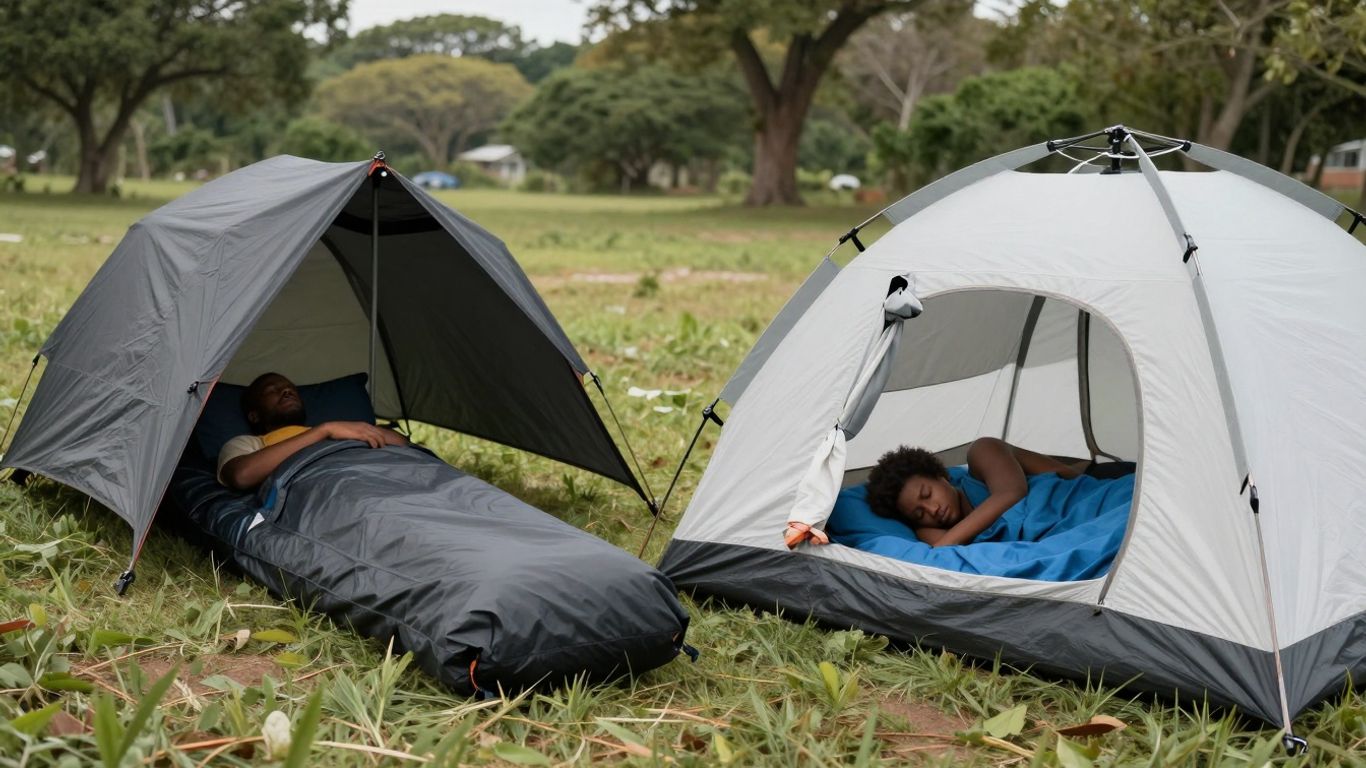
When considering whether bivouacking or camping is a better fit, there are a few points to look at. It's not that one is generally better than the other. It really depends on what you plan to do and what is important to you.
Protection, weight, and setup time
The biggest difference probably lies in the protection you get. A bivy sack protects you from the worst wind and rain, but it's not a full-fledged tent. If it's really stormy or pouring, it can quickly get uncomfortable in a bivy sack. A good tent offers significantly more safety and comfort, especially when the weather turns. However, a bivy sack is tiny and weighs almost nothing. You can easily tuck it into a jacket pocket. A tent, even a light trekking tent, takes up more space and is noticeably heavier. You'll notice that when you've been on the go all day.
When it comes to setup, the bivouac is unbeatable. You unpack your sack, lie down, done. That takes maybe two minutes. Setting up a tent can take ten or twenty minutes, depending on the model and practice. This is especially an issue when you're running late or the weather turns bad.
Visibility and legal assessment
Another point is how conspicuous you are. With a bivy sack, you are relatively inconspicuous. You might be lying under a tree or in a hollow, and when you move on in the morning, there are hardly any traces to be seen. This is often why bivouacking is tolerated in some areas where camping is strictly forbidden. A tent, on the other hand, is much more visible. It stands there, you can see it from a distance. This can quickly be interpreted as illegal camping, and that can cause trouble, including fines.
The legal situation is often clearer here. Camping is usually only allowed at designated campsites. Bivouacking, especially emergency bivouacs, is often seen as a kind of "emergency overnight stay" that is tolerated as long as you leave no trace and move on quickly. But be careful: this is not the case everywhere. In some regions, bivouacking is also considered camping and is therefore forbidden.
Comfort and cost in comparison
When it comes to comfort, the tent clearly has the upper hand. You have more space, can perhaps even sit down, organize your things better, and are better protected from insects. A bivy sack is cramped; you lie down the whole time. If it's warm, it can quickly get stuffy inside. If it's cold, you need a very good sleeping bag and a good sleeping pad to avoid freezing.
In terms of cost, bivouacking is usually cheaper. A good bivy sack is not a huge investment. A decent tent that can withstand bad weather can cost several hundred euros. So, if you only want to spend the night outdoors occasionally and can do without maximum comfort, bivouacking is the more economical option. For regular tours with more comfort, a tent is the better choice, even if it's more expensive.
|
Criterion |
Bivouac |
Tent |
|---|---|---|
|
Weather protection |
Limited (depending on bivy sack) |
Very good (with high-quality tent) |
|
Weight & pack size |
Very light and compact |
Significantly heavier and larger |
|
Setup time |
None / minimal |
Varies depending on tent model |
|
Visibility |
Low |
High |
|
Legal assessment |
Often tolerated or permitted |
Mostly forbidden outside official sites |
|
Insect protection |
Only with mesh or closed sack |
Usually integrated |
|
Cost |
Cheaper entry possible |
More expensive to purchase and maintain |
Conclusion: Bivouacking or Camping – What's Right for You?
So, at the end of the day, the choice between bivouacking and camping isn't that complicated. If you're into minimalism, don't want to carry much, and are looking for a real adventure, then bivouacking might be exactly your thing. You'll be close to nature, feel every breath of wind, and learn to get by with what you have. But be honest with yourself: are you ready for a little discomfort?
On the other hand, if you value comfort, want to be protected in any weather, or simply want to enjoy your tour in a relaxed way, then a tent is the better choice. It offers more protection, is often more spacious, and gives you a sense of security, especially if you don't have much experience yet. Just think about what's most important to you on your next tour – then you'll find the right overnight accommodation.
Frequently Asked Questions about Bivouacking
What is the main difference between bivouacking and camping?
When bivouacking, you usually sleep only with a bivvy bag and sleeping mat under the open sky or under a tarp. A tent, on the other hand, offers much more protection from wind, rain, and insects. Bivouacking is therefore much simpler and lighter, but also less comfortable than camping.
When is bivouacking a good idea?
Bivouacking is great if you want to travel very light, for example, on long hikes where there are no huts. It's also great if you're looking for a real adventure and want to feel close to nature. Sometimes it's also a good emergency solution if the weather suddenly changes.
What do I absolutely need for bivouacking?
The most important thing is a bivvy bag that protects you from wetness and wind. This definitely includes a sleeping mat to protect against the cold from below and a warm sleeping bag. An emergency bivvy bag is also a good idea in case something unforeseen happens.
Is bivouacking allowed everywhere?
No, it's not allowed everywhere. In Germany, for example, it's often regulated differently from state to state. In nature reserves, it's usually forbidden. However, an emergency bivouac, if you really have to, is often tolerated. It's best to find out exactly where you are beforehand.
What do I need to consider to bivouac safely?
You always have to keep an eye on the weather, because it can change quickly. Pay attention to your surroundings so that you don't get into danger, for example, from rockfalls. Wild animals are usually not a big problem, but you should store your food well. And most importantly: leave no trash!
Is bivouacking more dangerous than camping?
It can be riskier because you have less protection. You are more directly exposed to the elements. But if you are well prepared, have the right equipment, and can assess the weather and your surroundings well, it is not necessarily more dangerous. It just requires more knowledge and caution.







Share:
Merino vs. Synthetics: Why Your Hiking Shirt Never Has to Smell Again
Cabin Outfit - The best ideas!